
Inventory Management for Small Business: 15 Ways to Reduce Stock Loss
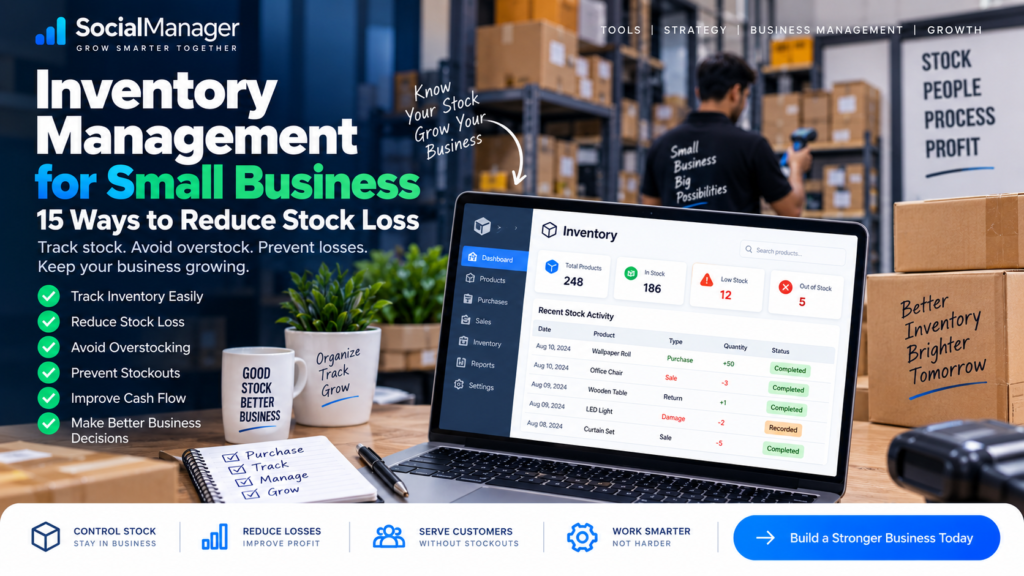
You check your records and the system says you have 25 units in stock.
A customer places an order.
Then someone checks the shelf.
Only 17 units are actually there.
Where did the other eight go?
Maybe some were sold but never recorded. Maybe two were damaged. Maybe someone used stock internally. Maybe a supplier delivered fewer units than the invoice showed. Or perhaps the stock count was wrong from the beginning.
For a large company, an inventory mismatch is a problem.
For a small business, repeated inventory mistakes can directly affect cash flow, customer trust and profit.
That’s why inventory management for small business is not simply about knowing how many products are sitting on a shelf. It is about knowing:
what you have, what you sold, what you purchased, what you lost, what you need to reorder, and how much money is tied up in stock.
Good inventory management also creates better business records. Formal recordkeeping guidance consistently emphasizes maintaining accurate records of purchases, sales and inventory-related transactions because those records help a business understand its performance and prepare reliable financial information.
In this guide, we’ll look at 15 practical ways to improve inventory management for small business, without turning a simple business into an unnecessarily complicated warehouse operation.
What Is Inventory Management for Small Business?
Inventory management for small business is the process of tracking products and materials from purchase or production through storage and eventual sale, use, return, damage or disposal.
In simple terms, it should answer questions such as:
What do I have right now?
Where is it?
How much did I buy?
How much did I sell?
What is running low?
What hasn’t sold for months?
Which items are damaged or missing?
How much money is currently locked in inventory?
Depending on the business, inventory may include finished products, raw materials, parts or supplies that become part of products intended for sale.
For example, inventory for a clothing shop may be shirts, trousers and dresses.
For a furniture business, it might include finished furniture plus certain materials.
For an electronics retailer, it could be individual devices and accessories.
The exact system will differ.
The basic principle won’t:
Every stock movement should have a reason and a record.
Why Inventory Management for Small Business Matters
Imagine you have ₹5 lakh invested in stock.
If ₹1 lakh of that stock has barely moved for a year, that money isn’t freely available for rent, salaries, marketing or faster-selling products.
Now imagine your best-selling item repeatedly goes out of stock.
You have the opposite problem.
Customers want something you could have sold—but you don’t have it.
This is why small business inventory management needs to balance two risks:
Too little stock → lost sales
Too much stock → trapped cash
And between those two sits another problem:
incorrect stock → unreliable decisions
Good records can help businesses identify which items are selling and what changes may be needed.
So let’s fix the system from the beginning.
Accurate inventory records are part of good business recordkeeping. For a general overview of why businesses should maintain reliable records of purchases, sales and inventory-related transactions, you can also read the IRS Small Business Recordkeeping Guide. This is a general recordkeeping reference, not India-specific tax advice.
1. Create One Master Inventory List
The first step in inventory management for small business is surprisingly basic:
Know exactly what you’re tracking.
Create one master list of inventory items.
Each item should have enough information to identify it clearly.
For example:
Item: Premium Wallpaper
SKU: WP-PREM-001
Category: Wallpaper
Unit: Roll
Purchase Cost: ₹1,500
Selling Price: ₹2,500
Current Stock: 24 rolls
Minimum Stock: 5 rolls
The exact fields depend on your business.
The important part is consistency.
Don’t call the same product:
Premium Blue Wallpaper
in one record,
Blue Premium
in another,
and
WP Blue
somewhere else.
That creates duplicate records and eventually inaccurate stock.
2. Give Every Product a Unique SKU
A SKU—Stock Keeping Unit—is an internal identifier you assign to an item.
Suppose you sell three visually similar products:
White curtain – 7 ft
White curtain – 8 ft
White curtain – 9 ft
If staff simply record:
White curtain sold
which one should be deducted from stock?
A basic SKU system solves this.
For example:
CUR-WHT-7
CUR-WHT-8
CUR-WHT-9
Your SKU doesn’t need to be complicated.
It needs to be unique and consistent.
Good inventory tracking for small business becomes much easier when every item has one identity.
3. Record Every Purchase Immediately
Your supplier delivers 50 units.
Someone places the invoice on the desk.
You’ll “enter it later.”
Then customers start buying those products.
Three days later, the purchase still hasn’t been entered.
Now your physical stock and recorded stock are already different.
This is how inventory problems begin.
When stock arrives:
verify it → record it → then make it available for sale.
Don’t assume the supplier’s invoice automatically equals what physically arrived.
Count the items.
Check the condition.
Confirm the quantity.
Record the actual receipt.
Good recordkeeping guidance recommends recording transactions promptly; delayed recording makes business records less reliable.
4. Deduct Stock With Every Sale
This sounds obvious.
Yet it is one of the easiest ways to create stock mismatch.
Suppose you start with:
100 units
and sell:
12 units
Your inventory should become:
88 units
But what happens when sales come from multiple places?
Shop counter.
Phone order.
WhatsApp.
Website.
Salesperson.
Manual invoice.
If one channel doesn’t update inventory, your records become wrong.
An effective inventory management system for small business should connect each completed sale with the corresponding stock reduction—or at minimum establish a reliable process for recording that reduction immediately.
5. Record Returns Separately
A customer returns a product.
Should you simply add it back to available inventory?
Not always.
Ask:
Is the item unopened?
Is it damaged?
Can it be sold again?
Does it need repair?
Should it be returned to the supplier?
A returned product may become:
sellable stock
or
damaged stock
or
supplier return
Treating every return as normal available inventory can make your stock count look correct while the shelf tells a different story.
Good inventory management for small business tracks the reason behind the movement, not just the quantity.
6. Track Damaged, Lost and Used Stock
This is where many stock systems quietly fail.
Imagine your records show:
50 units
Physical count shows:
46 units
Instead of simply changing 50 to 46, ask:
Why are four units missing?
Perhaps:
2 damaged
1 used as sample
1 missing
Record these separately.
This creates an audit trail.
Over time, patterns become visible.
If one category has unusually high damage every month, maybe storage needs improvement.
If stock frequently disappears without explanation, you have a different problem.
Simply correcting the final number hides the cause.
7. Set Minimum Stock Levels
You shouldn’t discover you’re out of stock when a customer asks for the product.
For important items, define a minimum level.
Example:
Current stock: 20
Minimum stock: 5
When inventory reaches five units, the item becomes a reorder candidate.
This is often called a reorder point.
A more useful reorder decision considers:
how quickly the item sells + how long the supplier takes to deliver + safety stock.
Suppose you sell approximately two units per day and your supplier takes five days.
Waiting until only two units remain is obviously risky.
A simple reorder system can prevent avoidable stockouts.
8. Don’t Overstock Slow-Moving Products
More inventory doesn’t always mean a stronger business.
Inventory uses cash.
Suppose you purchase 200 units because the supplier offers a discount.
Six months later you’ve sold only 20.
You saved money per unit.
But a large amount of your cash is now sitting on a shelf.
This is why inventory management for small business must look at movement, not just quantity.
Separate items into categories such as:
Fast-moving
Normal-moving
Slow-moving
Non-moving/dead stock
This gives you a much clearer picture of what your purchasing decisions are doing to cash flow.
9. Identify Dead Stock Before It Becomes a Bigger Problem
Dead stock is inventory that is no longer selling or is extremely unlikely to sell normally.
Examples may include:
outdated designs,
old models,
seasonal products after the season,
obsolete technology,
wrong sizes,
discontinued items.
A business can appear to have a warehouse full of valuable stock while much of that inventory isn’t realistically converting into cash.
Review aging inventory regularly.
For example:
0–30 days
31–60 days
61–90 days
91–180 days
180+ days
The exact periods depend on your industry.
The purpose is simple:
Don’t wait until stock has been sitting for two years before asking why it isn’t selling.
10. Perform Regular Physical Stock Counts
Software doesn’t magically make inventory correct.
If someone enters the wrong quantity, the software will accurately store the wrong number.
That’s why physical counting matters.
Compare:
System quantity
with
Physical quantity
If the system says 42 and the shelf has 39, investigate the difference.
For a very small business, a full monthly count may be practical.
For businesses with more products, cycle counting can be easier: count different groups of inventory on a rotating schedule.
For example:
Monday: Category A
Tuesday: Category B
Wednesday: Category C
Then repeat according to the risk and value of the stock.
The goal is to find discrepancies early rather than discovering them at year-end.
11. Track Stock Adjustments With a Reason
Suppose the system says:
120 units
Physical stock says:
115
Someone edits the system:
120 → 115
Problem solved?
Not really.
Five units disappeared and nobody knows why.
Every manual stock adjustment should ideally include:
Old quantity
New quantity
Difference
Reason
Date
Person responsible
For example:
120 → 115
Adjustment: -5
Reason: 3 damaged, 2 missing
Now you have information that can actually improve the business.
This is a major difference between basic stock counting and proper inventory management for small business.
12. Know the Difference Between Stock Quantity and Stock Value
Having 1,000 items doesn’t tell you how much inventory is worth.
Consider:
Product A: 500 units × ₹20 cost = ₹10,000
Product B: 50 units × ₹2,000 cost = ₹1,00,000
Product A has ten times more units.
Product B has ten times more money tied up.
So don’t manage inventory using quantity alone.
Track both:
Quantity on hand
and
Inventory value
Inventory valuation also matters for financial reporting and cost-of-goods calculations. Formal accounting guidance treats beginning and ending inventory as relevant to determining cost of goods sold where applicable.
For tax treatment and valuation methods in India, use the rules applicable to your business and consult a qualified accountant where necessary.
13. Connect Purchases, Sales and Inventory
Inventory shouldn’t operate as an isolated notebook.
Think about this transaction:
You buy 10 chairs from a supplier.
That’s a purchase.
The chairs enter inventory.
You sell two chairs.
That’s a sale.
Inventory should decrease by two.
The customer pays.
That’s a payment.
Your business records should ultimately make these events understandable together.
This is one reason digital business systems become useful as transaction volume grows.
Electronic systems are perfectly capable of maintaining business records, but the fundamental requirement remains the same: records need to be complete and accurate.
If you’re still managing different parts of the business separately, SocialManager’s broader business-management direction is designed around bringing day-to-day business records such as items, purchases, sales and inventory into a more organized workflow.
14. Stop Depending on Memory
Small businesses often begin like this:
“I know what’s in stock.”
That can work when you have 10 products.
Then you have 50.
Then 200.
Then another employee starts selling.
Then customers order over WhatsApp.
Then supplier prices change.
Eventually, the business becomes too complicated for one person’s memory.
Your inventory system should be able to tell you what’s happening even when the owner isn’t physically standing in the shop.
That’s the point at which inventory tracking for small business becomes a process rather than a personal habit.
15. Review Inventory Reports and Act on Them
Collecting data has little value if nobody uses it.
At least periodically, review questions such as:
Which items sell fastest?
Which products are running low?
Which items haven’t sold recently?
Which category has the most money tied up?
Which items frequently have stock discrepancies?
Which products have high damage or return rates?
What needs to be reordered?
What should we stop buying?
Records should help you make decisions, not simply create paperwork.
This principle is reflected in formal small-business recordkeeping guidance: good records help owners monitor progress, understand which items are selling and identify changes the business may need.
How to Manage Inventory for a Small Business
If you’re starting from zero, don’t overcomplicate it.
Use this workflow:
1. Create your product/item master.
2. Give each item a unique SKU.
3. Enter opening stock.
4. Record every purchase when goods are received.
5. Record every sale.
6. Record customer returns.
7. Record supplier returns.
8. Record damage, loss and internal use separately.
9. Set low-stock levels for important items.
10. Perform regular physical counts.
11. Investigate differences.
12. Review fast, slow and dead stock.
That’s the foundation of practical inventory management for small business.
Excel vs Inventory Management System for Small Business
A common question is:
“Do I actually need inventory software?”
Not necessarily on day one.
Excel or Google Sheets Can Work When:
You have very few products.
One person manages stock.
Transaction volume is low.
You can consistently update the sheet.
There are no complicated warehouses or sales channels.
A spreadsheet is far better than no system.
But problems appear as the business grows.
Two people edit different copies.
A sale isn’t entered.
A formula breaks.
Someone overwrites a cell.
Returns aren’t tracked separately.
You don’t know who adjusted stock.
That’s when an inventory management system for small business becomes more valuable.
A proper system can make it easier to connect:
sales,
purchases,
items,
stock movements,
returns,
low-stock levels,
and reports.
The right time to switch isn’t determined by the age of your business.
It’s when your current method stops producing reliable information.
A Simple Inventory Formula Every Small Business Should Understand
At a basic operational level:
Closing Stock = Opening Stock + Stock In − Stock Out ± Adjustments
Example:
Opening stock = 100
Purchased/received = 50
Sold = 35
Customer return back to sellable stock = 2
Damaged = 3
Then:
100 + 50 − 35 + 2 − 3 = 114 units
Your expected closing stock is:
114 units
Now physically count the product.
If you find 110, you have a discrepancy of four units.
Don’t just change 114 to 110.
Investigate the four.
That investigation is where inventory control begins.
Inventory Management for Small Business: Common Mistakes
Several mistakes repeatedly create inventory problems:
- updating stock days after transactions happen
- using different names for the same product
- failing to create unique SKUs
- treating damaged returns as normal stock
- ignoring supplier shortages
- adjusting quantities without recording reasons
- purchasing too much because of discounts
- failing to identify dead stock
- never physically counting inventory
- tracking quantity but ignoring value
- allowing anyone to edit stock without accountability
- keeping purchase, sales and stock records disconnected
If your physical inventory rarely matches your records, don’t assume you simply need better software.
First inspect the process.
Software can automate a good process.
It can also automate a bad one.
How Often Should a Small Business Count Inventory?
There isn’t one schedule that fits every business.
A shop with 30 products and a warehouse with 10,000 SKUs shouldn’t use the same counting process.
A practical approach is to count higher-value and faster-moving products more frequently.
For example:
High-value/fast-moving: weekly
Normal inventory: monthly
Slow-moving: quarterly
Then perform a broader physical verification periodically according to the needs of the business.
If an item frequently shows discrepancies, count it more often until you identify the cause.
The purpose isn’t to spend all day counting.
The purpose is to trust the number displayed in your system.
How to Reduce Stock Loss in a Small Business
Start by making every stock movement traceable.
If inventory leaves the shelf, there should be a reason.
Sale.
Damage.
Return.
Transfer.
Sample.
Internal use.
Loss.
Adjustment.
Then control who can make manual adjustments.
Review unusual differences.
Count valuable items more frequently.
Check goods when they arrive.
Don’t leave receiving until later.
And don’t confuse:
“The computer says we have it”
with
“We actually have it.”
The best small business inventory management combines digital records with physical verification.
How Inventory Management Improves Cash Flow
Inventory is money in another form.
You spend cash to buy stock.
That cash becomes inventory.
When inventory sells profitably and the customer pays, it becomes cash again.
Problems occur when too much money gets trapped between those stages.
Suppose:
₹3,00,000 is invested in stock.
₹1,50,000 of that stock moves quickly.
₹50,000 moves slowly.
₹1,00,000 hasn’t moved for months.
You may think:
“We have ₹3 lakh of stock.”
Operationally, the more important question is:
“How much of that stock is likely to convert into cash soon?”
This is why inventory management for small business is also cash-flow management.
Can Inventory Management Increase Profit?
Inventory software itself doesn’t create profit.
Better decisions can.
Consider the potential effects:
Fewer stockouts can prevent missed sales.
Less overstock can free cash.
Finding damaged inventory earlier can reduce hidden losses.
Identifying dead stock can improve purchasing decisions.
Accurate cost information can improve pricing decisions.
Better records can expose recurring discrepancies.
That’s the value of inventory management.
Not having more reports.
Having better decisions.
Inventory Management for Service Businesses
You might think inventory management only matters to retailers.
Not always.
A service business may use:
materials,
spare parts,
consumables,
hardware,
samples,
or products installed at customer sites.
For example, an interior business might purchase materials for a customer project.
Those materials still need tracking.
You may need to know:
what was purchased,
for which project,
how much was used,
what remained,
what was returned,
and whether unused material went back into general stock.
The inventory workflow should reflect the actual business rather than forcing every company into a retail-store model.
Inventory Management Checklist for Small Business
Before considering your system reliable, check whether you can answer these questions:
Can every item be uniquely identified?
Do you know the current quantity?
Do you know its purchase cost?
Are purchases recorded when stock arrives?
Are sales deducted consistently?
Are customer and supplier returns tracked?
Is damaged stock separated?
Are manual adjustments recorded with reasons?
Do important products have low-stock levels?
Do you regularly compare system stock with physical stock?
Can you identify slow and dead inventory?
Can you estimate how much money is tied up in stock?
If several answers are “no,” your inventory management for small business still has gaps.
Frequently Asked Questions
What Is Inventory Management for Small Business?
Inventory management for small business is the process of recording, tracking and controlling products or materials as they are purchased, stored, sold, returned, damaged, transferred or otherwise used.
Why Is Inventory Management Important for a Small Business?
It helps a business understand what it has available, reduce stockouts, identify excess or dead inventory, investigate losses and make better purchasing and cash-flow decisions.
What Is the Best Way to Track Inventory for a Small Business?
Start with a clear item list, unique SKUs and a process that records every stock movement. Very small businesses may begin with a spreadsheet, while businesses with more transactions can benefit from an inventory management system.
Can I Manage Small Business Inventory in Excel?
Yes. Excel or Google Sheets can work for a small inventory with low transaction volume and disciplined manual updating. As products, users and transactions increase, maintaining accuracy can become harder.
When Should I Use an Inventory Management System for Small Business?
Consider moving from spreadsheets when stock errors become frequent, multiple people handle transactions, product volume increases, or you need sales, purchases, returns, adjustments and reports to work together.
How Do I Know When to Reorder Stock?
Set a reorder point based on sales rate, supplier lead time and an appropriate safety-stock buffer. Don’t wait until the product reaches zero.
What Is Dead Stock?
Dead stock is inventory that has stopped selling or is unlikely to sell through normal demand. It ties up cash and storage space.
Why Does My Physical Stock Not Match My System?
Possible reasons include unrecorded sales, purchase-receiving errors, damaged goods, returns, internal use, theft/loss, duplicate items or incorrect manual adjustments. Investigate the cause rather than simply overwriting the system quantity.
How Often Should I Count Inventory?
It depends on product volume, value and risk. High-value or fast-moving products can be counted more frequently, while other items may be reviewed monthly or quarterly.
Does Better Inventory Management Reduce Business Losses?
It can help identify and prevent avoidable losses by making stock movements traceable, highlighting discrepancies, controlling overstock and reducing preventable stockouts.
Final Thoughts: Inventory Management for Small Business Should Stay Simple
You don’t need a huge warehouse to have an inventory problem.
You only need:
a product purchased but not recorded,
a sale forgotten,
a damaged item counted as sellable,
a return handled incorrectly,
or a stock adjustment nobody can explain.
Repeat those small mistakes every day and eventually the numbers become useless.
Effective inventory management for small business starts with one simple rule:
Every stock movement needs a record and a reason.
Know what came in.
Know what went out.
Know what was sold.
Know what was returned.
Know what was damaged.
Know what is running low.
Know what isn’t selling.
And regularly verify that the quantity in your records actually exists physically.
You can start with a spreadsheet.
You can later move to an inventory management system for small business.
The tool matters less than the reliability of the process behind it.
If you’re building your broader business systems as well, website visibility is another area worth checking. SocialManager’s Free SEO Audit guide explains how to identify website SEO problems, while its Free SEO Tools guide covers useful tools for auditing and improving a website.
Good inventory records tell you what’s happening inside your business.
Good website data tells you what’s happening with your online visibility.
Both are valuable for making decisions based on evidence rather than guesses.
For inventory management for small business, start small, keep the process consistent, and make accuracy more important than complexity.
Because if you can’t trust your stock number, you can’t confidently make the next purchase or sale decision.